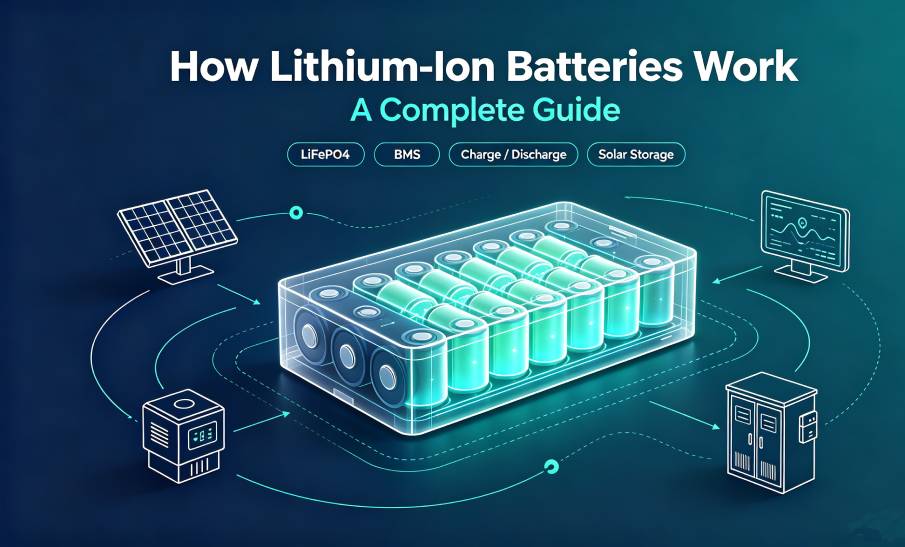
Lithium-ion batteries are highly efficient rechargeable electrochemical energy storage devices widely used in solar energy systems, household energy storage, commercial backup power, solar air conditioners, street lamps, and various electronic devices. Their core working principle relies on the reversible migration of lithium ions between the positive electrode (cathode) and negative electrode (anode) during charging and discharging. Through the cyclic conversion between electrical energy and chemical energy, the battery can store electricity when charging and provide stable power output when discharging. Compared with traditional lead-acid batteries, lithium-ion batteries have obvious advantages such as higher energy density, longer cycle life, lower self-discharge rate, and no memory effect. These characteristics make them the most ideal energy storage components in modern off-grid and grid-connected solar systems, supporting stable and reliable power supply for residential, commercial, and industrial scenarios.
The cathode is the main provider of lithium ions in the battery, usually made of lithium iron phosphate (LiFePO4), lithium manganese oxide, or ternary materials. It directly determines the battery’s nominal voltage, standard capacity, thermal stability, and overall safety performance. During the charging process, a large number of lithium ions are released from the cathode to participate in electrochemical reactions, which lays the foundation for energy storage.
The anode is generally composed of graphite or other carbon-based materials with a layered porous structure. This special structure allows lithium ions to be quickly inserted and stably stored during charging, and evenly released during discharging. The structural stability of the anode determines the cycle life and charging-discharging efficiency of the battery, especially in high-rate working conditions.
The electrolyte is an ion-conductive medium, usually an organic solution containing lithium salts. Its main function is to provide a smooth transmission path for lithium ions between the cathode and anode, ensuring the continuity and stability of internal electrochemical reactions. The performance of the electrolyte directly affects the low-temperature adaptability, safety, and service life of the battery.
The separator is a porous insulating film placed between the cathode and anode. It can effectively prevent direct physical contact between the positive and negative electrodes to avoid internal short circuits. At the same time, its dense microporous structure allows lithium ions to pass freely, ensuring the normal progress of energy conversion reactions.
Current collectors are usually made of copper and aluminum materials, responsible for collecting and conducting electrons in the external circuit. They form a complete closed loop during charging and discharging, ensuring the smooth input of electrical energy during charging and the stable output of current during discharging.
Charging is the process of converting external electrical energy into chemical energy and storing it inside the battery. When an external power supply such as a solar panel or charger applies a forward voltage to the battery, an electric field is formed inside the battery. Under the action of the electric field, lithium atoms in the cathode lose electrons and form positively charged lithium ions. Driven by the potential difference, these lithium ions detach from the cathode material, pass through the electrolyte and the separator, and embed into the layered structure of the anode. At the same time, electrons flow from the cathode to the anode through the external circuit. When the number of embedded lithium ions reaches saturation, the battery is fully charged, completing the entire energy storage process.
Discharging is the reverse process of charging, which converts stored chemical energy into usable electrical energy to supply external loads. When the battery supplies power to equipment such as solar air conditioners, lighting systems, or household appliances, lithium ions stored in the anode are released again. They pass through the separator and electrolyte and return to the cathode. Meanwhile, electrons flow from the anode to the cathode through the external circuit, forming a continuous and stable current to drive the normal operation of electrical equipment. This reaction is highly reversible and will not cause obvious damage to the internal structure of the electrode, so the battery can maintain stable performance after thousands of cycles.
The repeated shuttling movement of lithium ions between the cathode and anode is known as the rocking-chair mechanism. Unlike traditional batteries that rely on irreversible chemical reactions, lithium-ion batteries only involve the insertion and extraction of ions, without material corrosion or structural damage. This unique mechanism gives lithium-ion batteries extremely long cycle life, high energy conversion efficiency, low internal resistance, and stable output characteristics. In addition, lithium-ion batteries have no memory effect, meaning users can charge or discharge at any time according to actual needs without affecting battery capacity and service life.
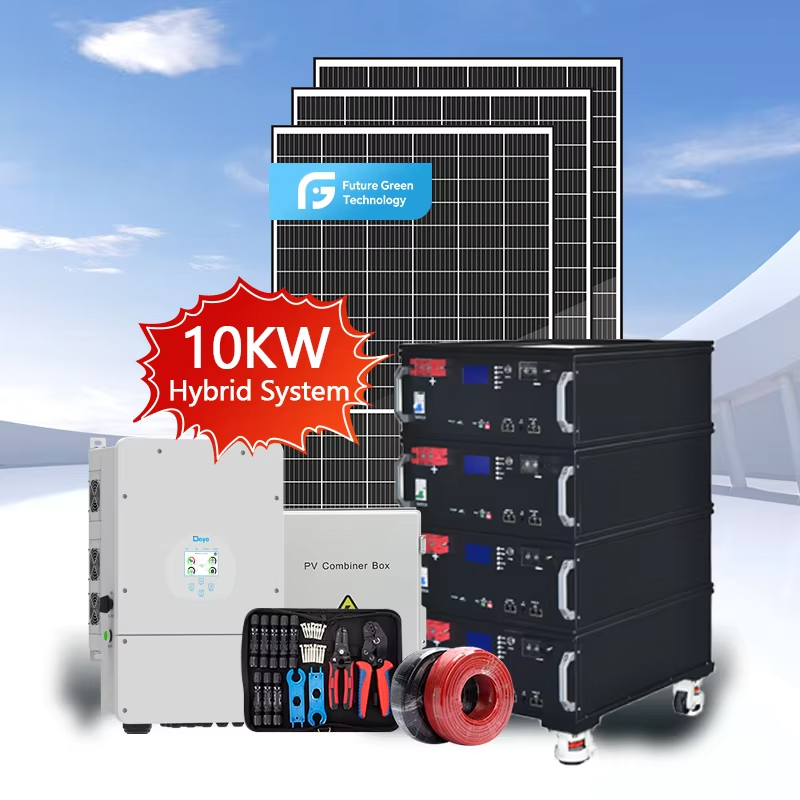
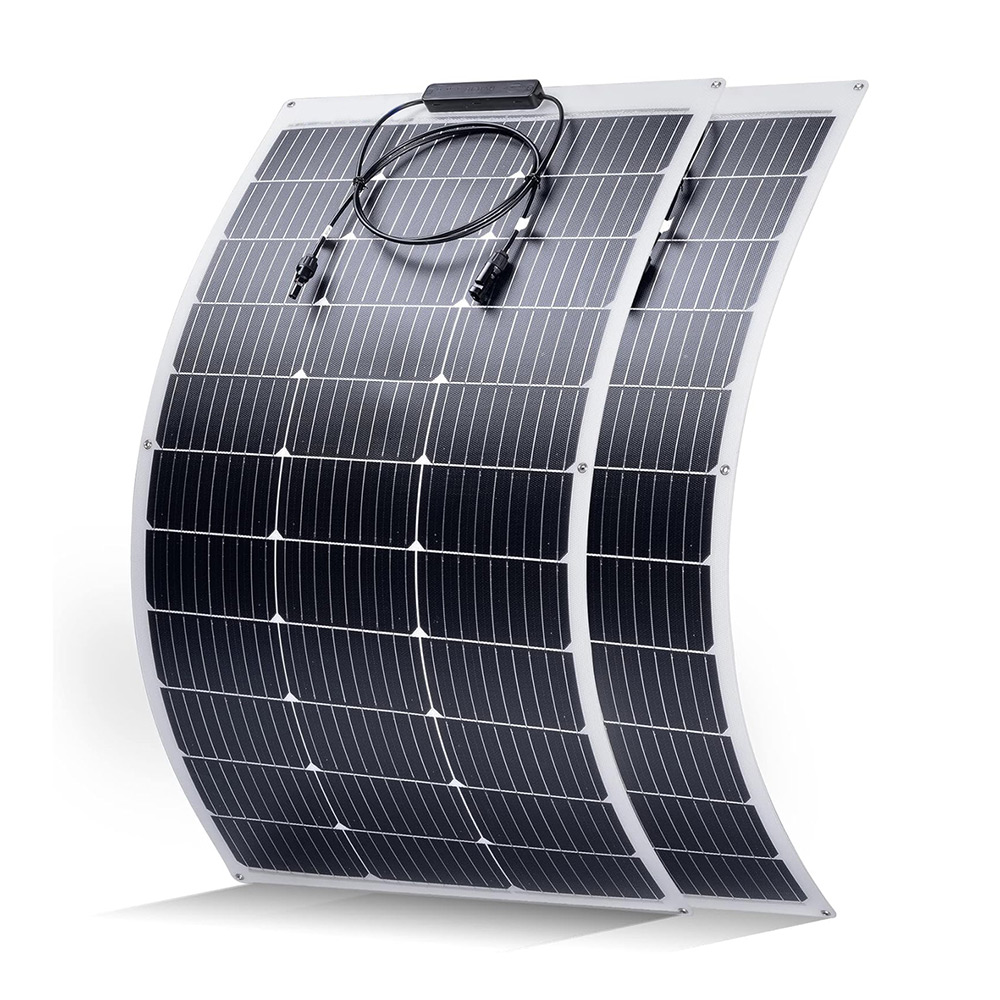
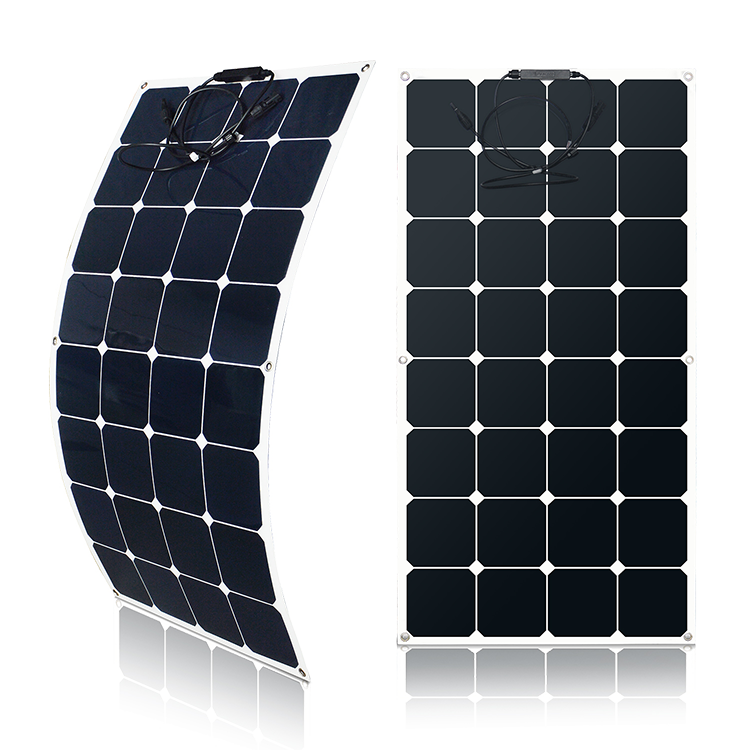
In off-grid and grid-connected solar energy systems, lithium-ion batteries act as core energy buffers. They absorb excess power generated by solar panels during the daytime and store it in the form of chemical energy. At night, on cloudy days, or under weak light conditions, the battery automatically discharges to supplement power supply, ensuring 24-hour uninterrupted operation of loads. With high safety, wide temperature adaptability, stable voltage output, and fast response speed, lithium-ion batteries effectively improve the stability and energy utilization rate of solar systems. They have become essential energy storage equipment in residential energy storage, commercial backup power, industrial microgrids, and various off-grid solar projects around the world.

Monday -Sunday: 8:00 - 24:00
No.13 Shang Zhen East RD., Taihe Town Baiyun Area, Guangzhou China
info@futuregreenbattery.com