A solar inverter is the core heart of the entire photovoltaic energy storage system. Its performance and configuration directly determine power generation efficiency, operational stability, and system scalability. For global residential and commercial solar projects, selecting a suitable inverter is the key to long-term stable power supply and cost savings. This article summarizes four core selection standards to help users and installers make professional and accurate choices.
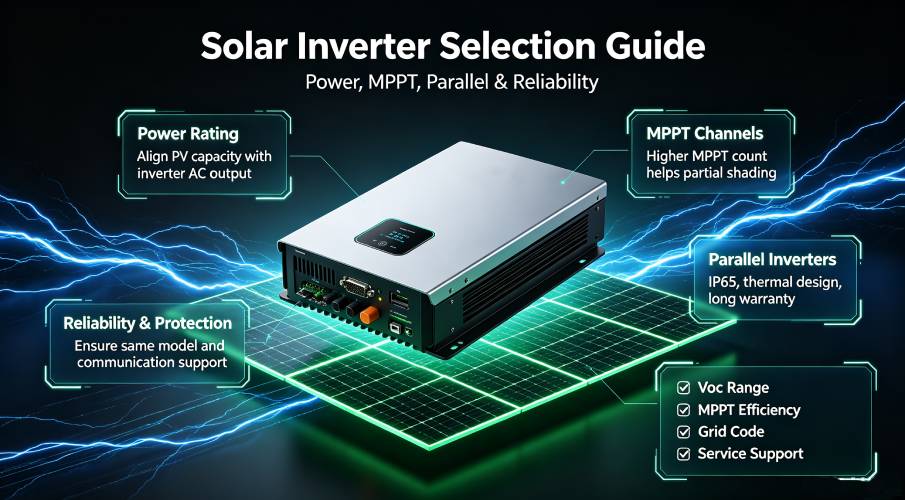
Power matching is the primary factor for inverter selection, which avoids insufficient power output or idle resource waste. Users need to confirm two core indicators: rated output power and peak power. The inverter’s continuous rated power must fully cover the total power of daily electrical loads, including conventional household appliances and commercial heavy-load equipment.
Meanwhile, it is necessary to reserve a certain power margin to cope with instantaneous startup current of inductive loads such as air conditioners and motors. For long-term system operation, it is recommended to support reasonable PV oversizing (150%-190%) to maximize solar energy harvesting in peak sunlight seasons. Proper power matching ensures no overload shutdown during peak power consumption and maintains stable long-term operation of the system.
MPPT (Maximum Power Point Tracking) technology decides the actual power generation efficiency of solar panels, especially in complex outdoor environments. Dual or multiple MPPT channels are far more advantageous than single MPPT models, which can independently track the maximum power point of different solar panel arrays.
For roofs with partial shading, uneven lighting, or different installation angles, multi-channel MPPT can effectively avoid overall power reduction caused by local shading of a single panel. High-precision MPPT tracking and wide PV voltage range adapt to various light conditions from weak light to strong sunlight, greatly improving the overall power generation rate and making the system more adaptable to complex global installation scenarios.
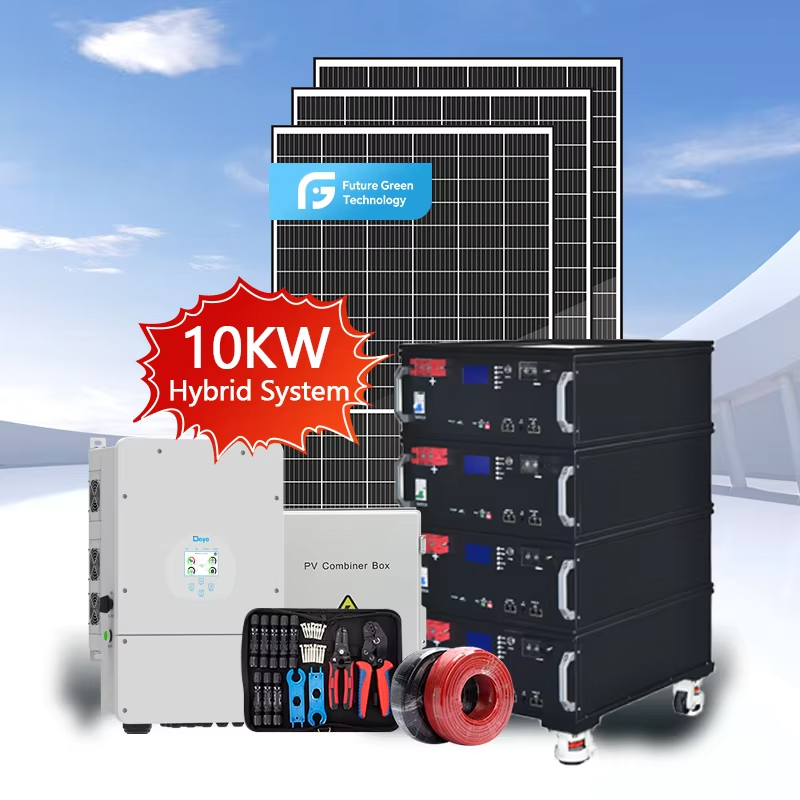
Parallel function is an essential configuration for medium and large solar storage systems, solving the problem of insufficient single-machine power and realizing flexible capacity expansion. Excellent hybrid inverters support multiple units parallel operation, usually allowing 1-6 units parallel connection to expand the overall system power freely.
This scalable design is suitable for both household power upgrade demands and small commercial project capacity expansion. Users do not need to replace the entire system when power demand increases, which greatly reduces later renovation costs. The synchronous parallel technology ensures balanced load distribution among each inverter, no power attenuation, and stable and consistent system output after capacity expansion.
In addition to the three major core indicators, practical auxiliary configurations determine the safety and convenience of long-term use. First, complete multi-layer safety protection functions including overcharge, overdischarge, overcurrent, overload, short circuit and overheating protection to avoid equipment failure and safety risks.
Second, rich communication interfaces such as WiFi, RS485 and CAN support remote real-time monitoring and intelligent energy management, facilitating users and installers to check operating data and troubleshoot remotely. Meanwhile, pure sine wave output design ensures safe power supply for precision electrical equipment, and high-standard indoor protection grade adapts to various installation environments, realizing low maintenance and long service life of the system.
Professional inverter selection needs to comprehensively consider power matching, MPPT efficiency, parallel scalability and overall reliability. Only by matching the most suitable inverter according to actual usage scenarios can we maximize power generation benefits, ensure stable power supply, and realize long-term energy-saving and cost-reducing value of solar storage systems.

Monday -Sunday: 8:00 - 24:00
No.13 Shang Zhen East RD., Taihe Town Baiyun Area, Guangzhou China
info@futuregreenbattery.com